Historical Context & Staging
The True Story, 1970s Asylums & Poor Theatre
What this task rewards: AO3 (Context)
For either OCR or Eduqas, context becomes useful when it changes a performance or design decision. Link a costume, lighting, acting or staging choice to a specific social, historical or theatrical context, then explain what the audience should understand from it. Eduqas assesses this play in Component 3; OCR uses it in Component 04.
📰 The True Story of Verity
Find Me is based on the devastating true story of a young woman using the alias 'Verity Taylor'. At the age of 20, she was a patient in a locked hospital ward. Out of profound frustration, she set fire to a chair.
- Rather than receiving therapeutic help, she was charged with arson.
- She was remanded in custody for 3 months.
- Following proceedings at Canterbury Crown Court, her parents were told that she would be admitted to Broadmoor Hospital, a high-security psychiatric hospital.
The ending invites an audience to question how a young woman whose family had repeatedly sought suitable care came to be dealt with through the court and high-security hospital system.
🏥 The 1970s Care System
The play sits in a period when mental-health care was changing and community provision was still developing. Wymark shows a family encountering repeated uncertainty over diagnosis, treatment and suitable placement. Avoid retrospectively diagnosing Verity: use the period language only when the text or source requires it, and explain that terminology has changed.
- Conflicting labels: the play presents different professional descriptions of Verity without a clear solution for the family.
- Treatment: medication and institutional routines are part of Verity’s experience; students should refer to the exact scene they have studied rather than generalising about all 1970s care.
- Provision: the social worker and consultant scenes explicitly expose shortages and the lack of a suitable environment for Verity.
🎭 Verbatim Elements
Olwen Wymark wrote the play in 1977 while working as a Writer in Residence at Kingston Polytechnic. She did not invent the dialogue from thin air.
Wymark drew on interviews with the family and material connected to the real case. The play uses narration, interview material, letters, direct address and episodes from different viewpoints. Treat “verbatim” carefully: in an exam, identify the documentary-like device you can actually point to rather than claiming every line is a verbatim transcript.
🪑 The Orange Tree & Minimal Staging
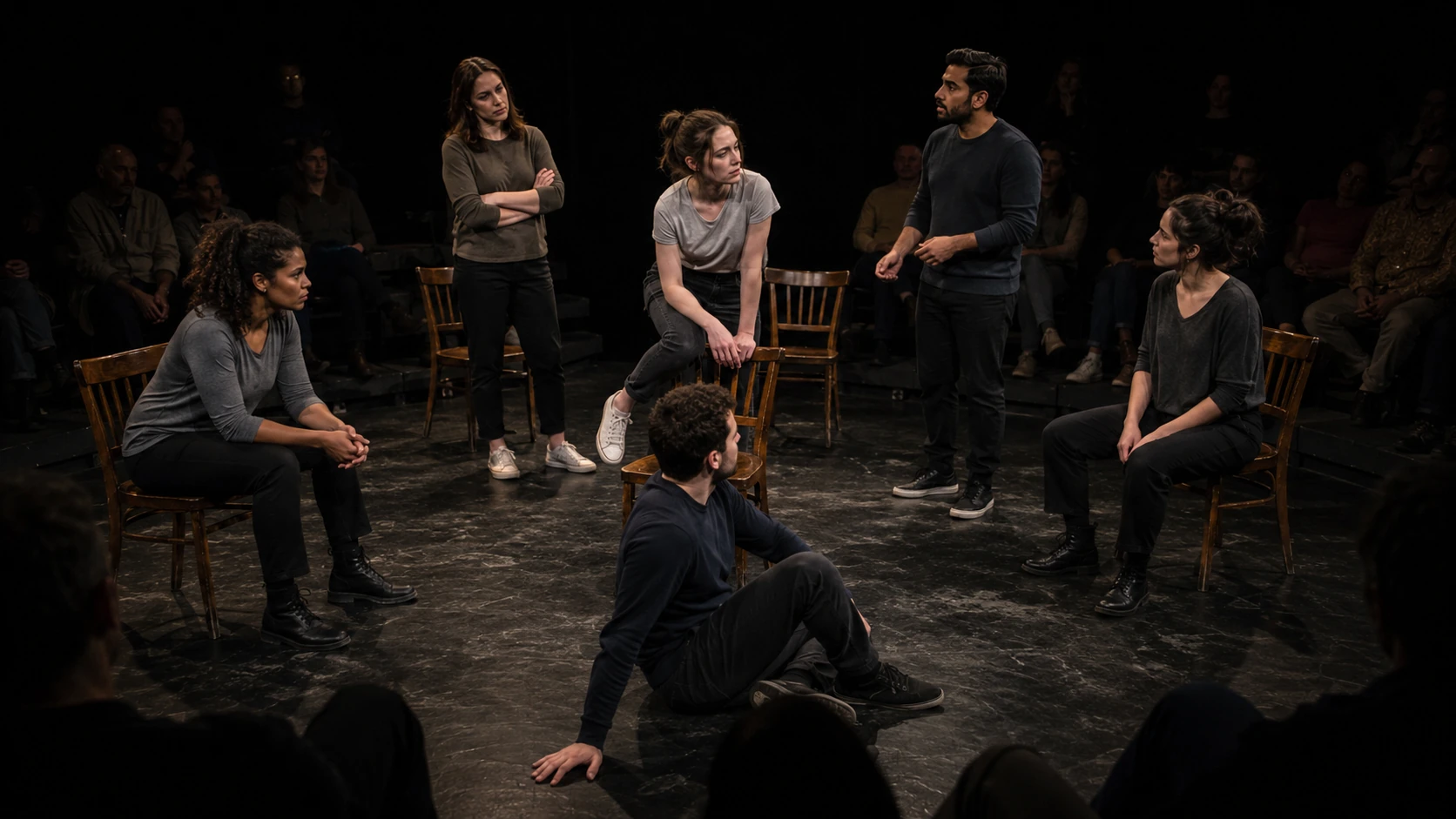
The original Orange Tree production used a cast of eight — five women and three men — with roles shared between performers. OCR records the staging as deliberately spare:
- Multi-roling: performers changed role, so body, voice and clear signifiers had to make those changes legible.
- Minimal production: the original had minimal costumes and no set or props.
- Poor Theatre link: OCR suggests this minimal approach can be linked to Jerzy Grotowski’s Poor Theatre. That is a useful comparison, not a rule that every modern production must copy.
✍️ Contextual Design Generator
Click the button to generate a high-level exam paragraph showing how you would use design to communicate the specific context of the play to a modern audience.
| Directorial/Design Idea | Contextual Justification (Why?) | Keywords to Use |
|---|---|---|
| Click the button above to generate a response... | ||