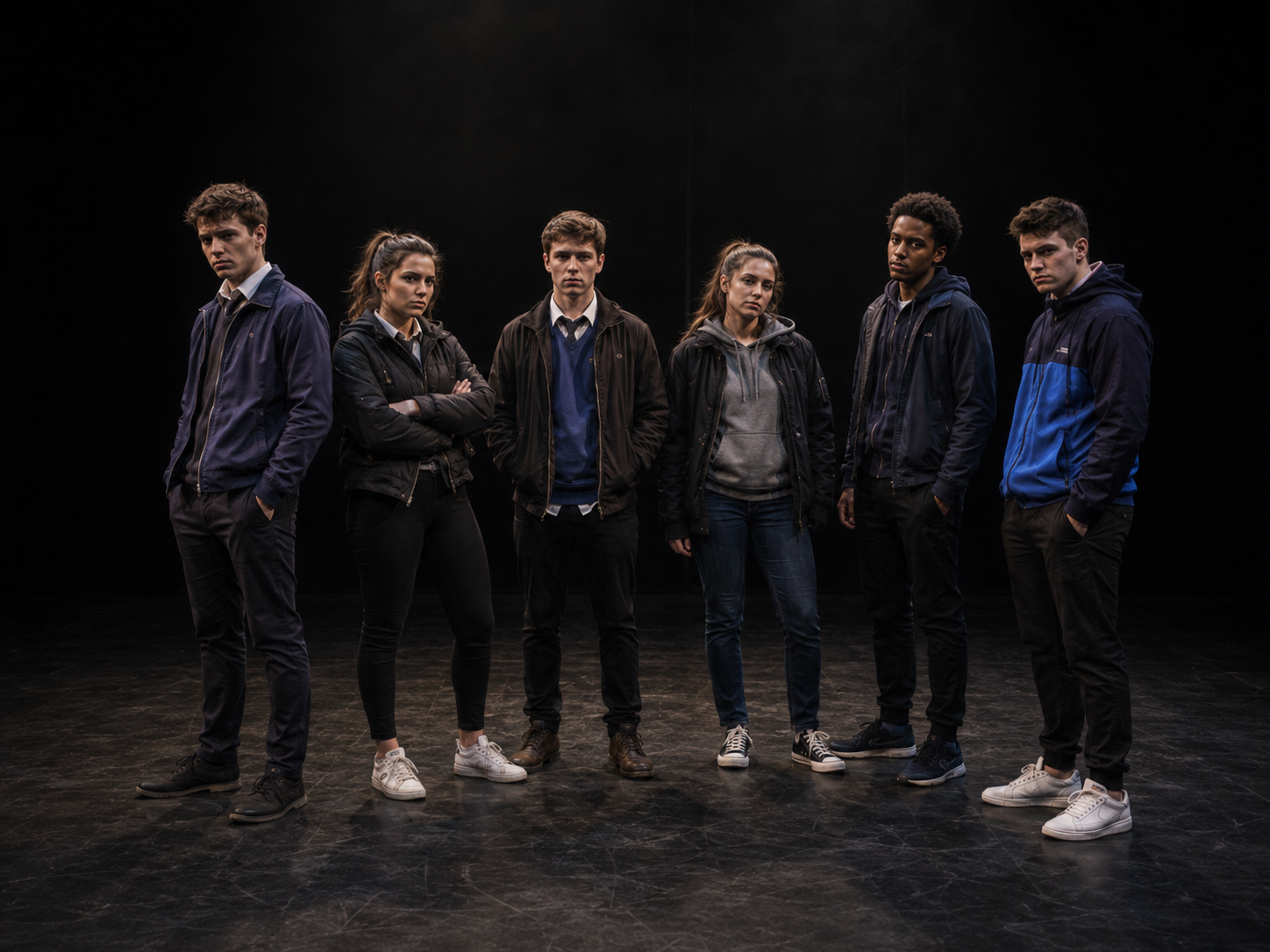
Turn the big ideas into things an audience can actually see and hear.
Text source:DNA by Dennis Kelly. Only very short cues are reproduced; use your prescribed edition for the complete text and exact scene context.
Theme through ensemble: the group matters more than any one realistic location. Belonging, pressure, isolation and hierarchy can all be made visible through one carefully arranged ensemble image.
Belonging & group pressure
The teenagers gain security from acting as a group, even when the group’s choices become harder to defend. Membership keeps changing: some people gain status, others are used, and Leah eventually leaves.
Stage it: begin with a tight shared formation, then show individuals being pushed to the edge or pulled back in when the group needs them.
Responsibility
Almost everyone can tell themselves that somebody else made the decisive choice. The play keeps passing responsibility around until the whole group becomes involved.
Stage it: use eye line so characters look towards a leader before acting. The audience can see responsibility being handed away.
Sacrifice & moral calculation
Phil repeatedly treats people as pieces in a solution. Kelly’s central question concerns the harm a group will justify when it believes the outcome protects the majority.
Stage it: keep Phil physically composed while the person being sacrificed carries the emotional and physical cost.
Bullying & violence
The original incident is built from group cruelty, but the play also shows psychological bullying: threats, exclusion, refusal to respond and pressure to comply.
Stage it: avoid making every threat loud. A quiet instruction delivered at close range can be more controlling than shouting.
Communication & silence
Jan and Mark often speak as a pair, Leah talks into Phil’s silence, and major events are reported rather than shown. How people communicate tells us who has power.
Stage it: decide when silence feels like uncertainty, refusal, control or emotional shutdown. Do not play every pause the same way.
Identity & gender
The published licensing information allows character names and genders to be changed. That makes behaviour and group role more important than assuming a fixed gender explanation for violence or leadership.
Stage it: test one scene with different casting choices and notice which status assumptions come from the text and which come from you.
Small quote bank, big acting choices
You do not need dozens of quotations for Drama. Learn a few short moments you can connect to performance.
Short cue
Useful idea
Performance route
“He’s dead.”
Shock / reporting / incomplete information
Shared rhythm, hesitation, eye line.
“What are we gonna do?”
Panic / search for leadership
Who speaks towards whom? Who does everyone look at?
Phil’s repeated silence
Communication / control
Stillness, food props, refusal of eye contact.
Leah leaving
Resistance / consequence
Empty space and the loss of her movement pattern.
Theme answer test
If your paragraph could fit an English Literature essay without changing a word, add theatre. Name the exact moment, actor or designer choice, and what the audience would notice.