Costume Design
Designing modesty, authority, and decay
Turn the interpretation into your own design
Open the standalone Costume Lab and choose The Crucible to compare costume interpretations, inspect detail, test audience readability and track continuity across the play.
Open Costume Lab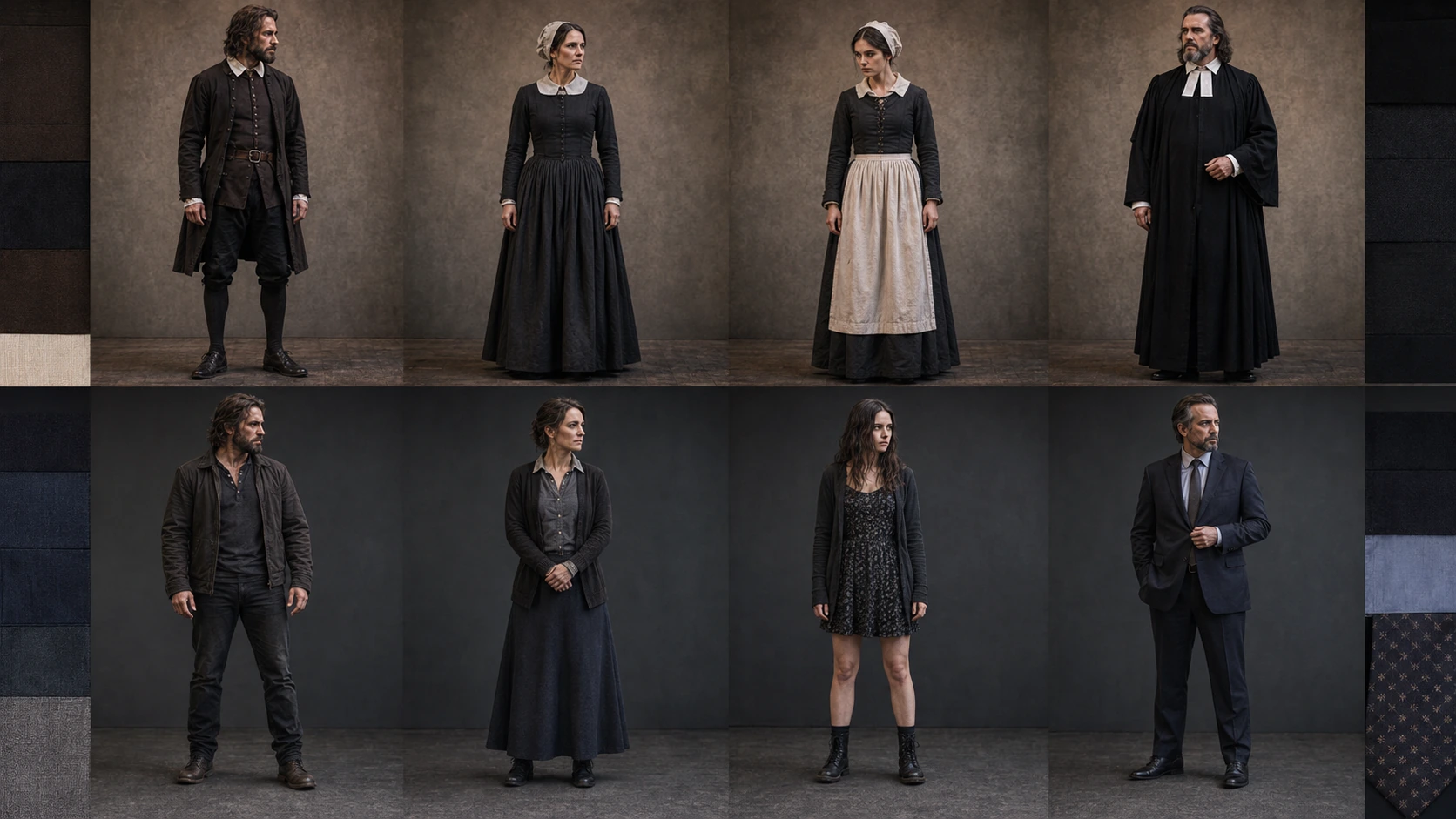
Interactive: The Salem Wardrobe
Choose a category to see how costume can communicate status, ideology and the physical cost of the trials.
The Farmers: honest & earthy
John and Elizabeth are working people. Their costume should read as practical, worn, and modest — without display or softness.
The look: grounded and functional.
Details: rough linen shirt (unbleached), dark wool breeches, scuffed boots. Rolled sleeves show labour and directness (a contrast to the court’s controlled polish).
The look: restrained, armoured, modest.
Details: heavy grey boiled wool dress, stiff high white collar restricting neck movement, hair fully hidden in a tight coif/bonnet. The costume makes emotional restraint physical.
Hysteria & decay: breakdown made visible
As pressure rises, rules fracture. Costume should show disintegration: loosened fastenings, dirt, sweat, torn linen, bare feet, and distressed fabric.
The look: controlled rebellion.
Details: still “modest” on paper, but collar slightly undone, bonnet slipping, loose hair framing the face. In a Puritan context, that looseness signals danger, sexuality, and rule-breaking.
The look: physically destroyed, morally clarified.
Details: barefoot, torn linen hanging loose, stained with dirt/sweat/blood, heavier beard + hollowed makeup. He has been stripped of identity markers — leaving only “name”.
Costume Terminology Bank
Breaking down / distressing
Artificially ageing or wearing a costume. If your Act 4 concept foregrounds imprisonment and elapsed time, selective dirt, wear, repairs or loosened fit can make that history visible.
Silhouette & modesty
Puritan costume hides the body. A rigid, boxy silhouette communicates repression and moral control.
Palette (earth tones)
Muted browns/greys/black suggest natural dyes and a joyless ideology. A controlled palette makes later breakdowns more visible.
Texture
Linen vs wool vs velvet. Texture communicates class instantly: court fabrics look heavier and more expensive than villagers’ workwear.
📝 Exam Builder: Costume paragraphs
Board-aware model paragraphs linking costume choices → meaning → audience impact.
Synopsis & Journeys
From whispered rumours to the gallows.
Context & History
1692 Salem, Puritanism, McCarthy allegory.
Characters & Acting
Status, control, and ensemble hysteria.
Key Scenes & Proxemics
Forest / farmhouse / courtroom / jail staging.
Themes & Quotes
Reputation, fear, authority — performance-led.
Design Elements
Set / lighting / sound / costume.