Characters & Acting
Performing paranoia, repression, and hysteria
Text source: The Crucible by Arthur Miller. Performance moments on this page point you back to the prescribed text rather than reproducing the dialogue; use your edition for exact wording.
Exam focus: what “acting answers” should sound like
Set your exam board to see what the selected board’s task rewards when you write about character performance.
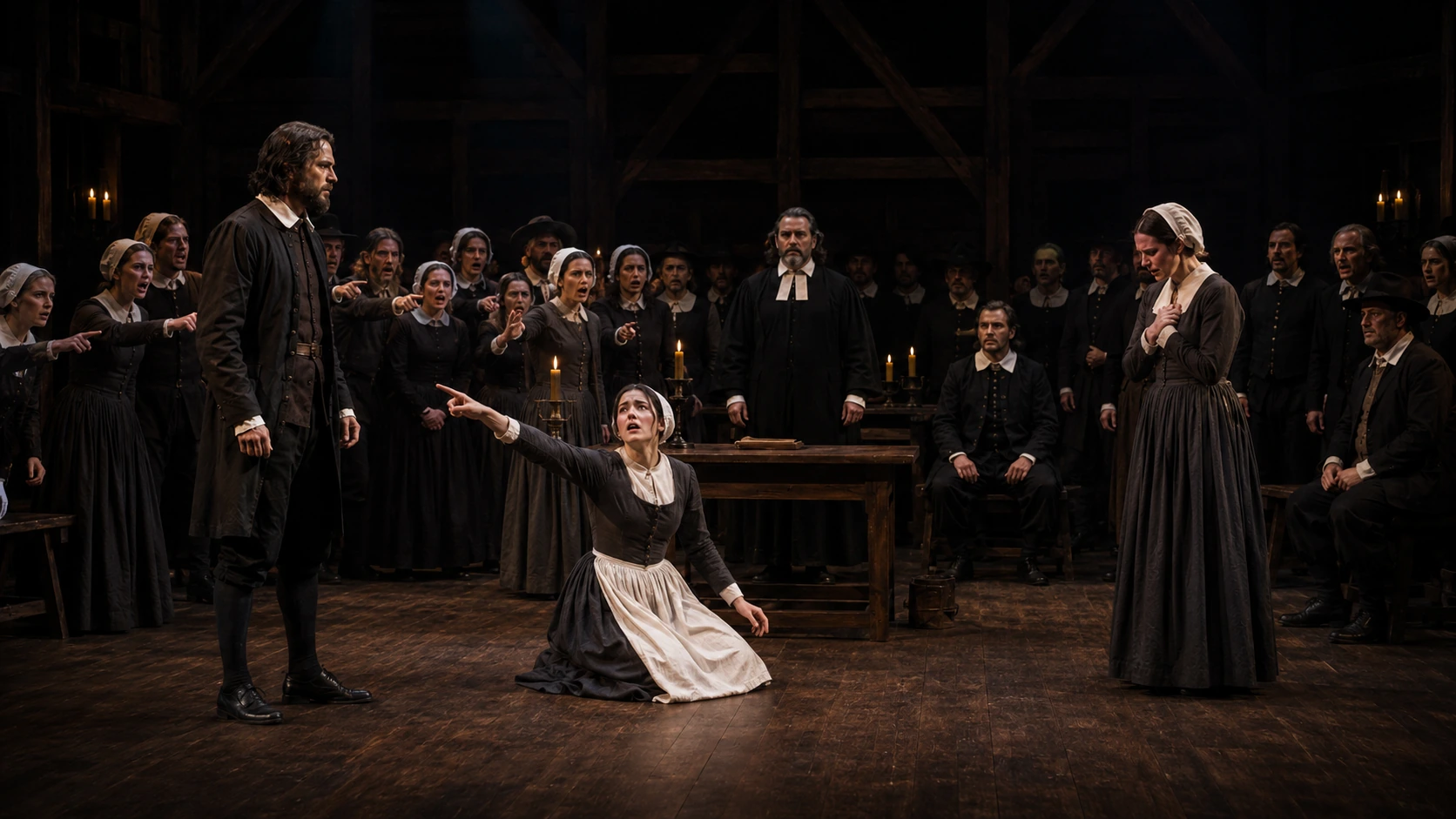
Choose a character to reveal their acting profile and power dynamics.
Select a Character
Choose a character to view acting notes, vocal skills, and physical journeys.
John Proctor
Status: Respected farmer | Theme: guilt, integrity, reputation
Proctor is the play’s moral centre: grounded, practical, and allergic to hypocrisy — while carrying his own. His acting journey is “contained pressure” turning into public rupture, then a final clarity.
🗣️ Vocal Skills
Baseline: low pitch, measured pace, controlled volume (a man who thinks before he speaks).
Under pressure: volume spikes into a roar; pace accelerates; breath fractures.
🚶 Physical Skills
Posture: grounded stance, feet planted, weight forward when challenging authority.
Gestures: practical, forceful actions (snatching paper, ripping, slamming hands) — anger becomes physical truth.
Abigail Williams
Status: orphan / accuser | Theme: manipulation, vengeance, survival
Abigail is not “randomly evil”. She is strategic: she reads the room and weaponises fear. Acting needs fast switches — innocence for authority, brutality for peers.
🗣️ Vocal Skills
Versatility: breathy “purity” for Danforth; harsh, spitting consonants when threatening the girls.
Control: she leads the pace of a scene by interrupting, escalating, and then “calming” when it benefits her.
🚶 Physical Skills
Proxemics: invades personal space to dominate (grabbing wrists/shoulders).
Switch: with authority figures she performs “contained” posture; with peers she becomes predatory.
Elizabeth Proctor
Status: respected wife | Theme: restraint, pain, forgiveness
Elizabeth’s acting power is in restraint. She holds emotion behind discipline — then reveals moral strength in her final choice to let John reclaim his name.
🗣️ Vocal Skills
Tone: clipped, careful, quiet. Pauses show thinking and emotional containment.
Key contrast: she is not “weak” — she is controlled.
🚶 Physical Skills
Posture: rigid spine; minimal gestures.
Proxemics: maintains distance from John in Act 2; refusal is physical (turning away, stepping back) not just verbal.
Deputy Governor Danforth
Status: supreme authority | Theme: absolutism, theocracy, self-protection
Danforth cannot allow doubt. Acting should show a man addicted to certainty: voice like a gavel, body like stone.
🗣️ Vocal Skills
Projection: booming volume, perfect articulation, controlled pace.
Power move: he cuts people off mid-sentence; he defines the rules of speech.
🚶 Physical Skills
Levels: keep him elevated (rostrum) wherever possible.
Movement: economical. A single finger-point or step forward is enough to intimidate the room.
Reverend Hale
Status: expert → outcast | Theme: broken faith, guilt
Hale’s journey is one of the clearest acting transformations in the play. He enters as certainty in human form; he leaves as guilt.
🗣️ Vocal Skills
Act 1: fast, eager, “academic” tone; enjoys being listened to.
Act 4: hoarse, pleading, breathless pace — a man trying to undo harm too late.
🚶 Physical Skills
Act 1: purposeful movement, books held like armour.
Act 4: shoulders collapsed, shaking hands, restless pacing — grief becomes visible.
📝 Exam Builder: Acting paragraphs
Generates board-aware model paragraphs linking vocal/physical choices to audience impact.
Synopsis & Journeys
From whispered rumours to the gallows.
Context & History
1692 Salem, Puritanism, McCarthy allegory.
Characters & Acting
Status, control, and ensemble hysteria.
Key Scenes & Proxemics
Forest / farmhouse / courtroom / jail staging.
Themes & Quotes
Reputation, fear, authority — performance-led.
Design Elements
Set / lighting / sound / costume.