Characters & Acting
Power Dynamics and Physical Deterioration
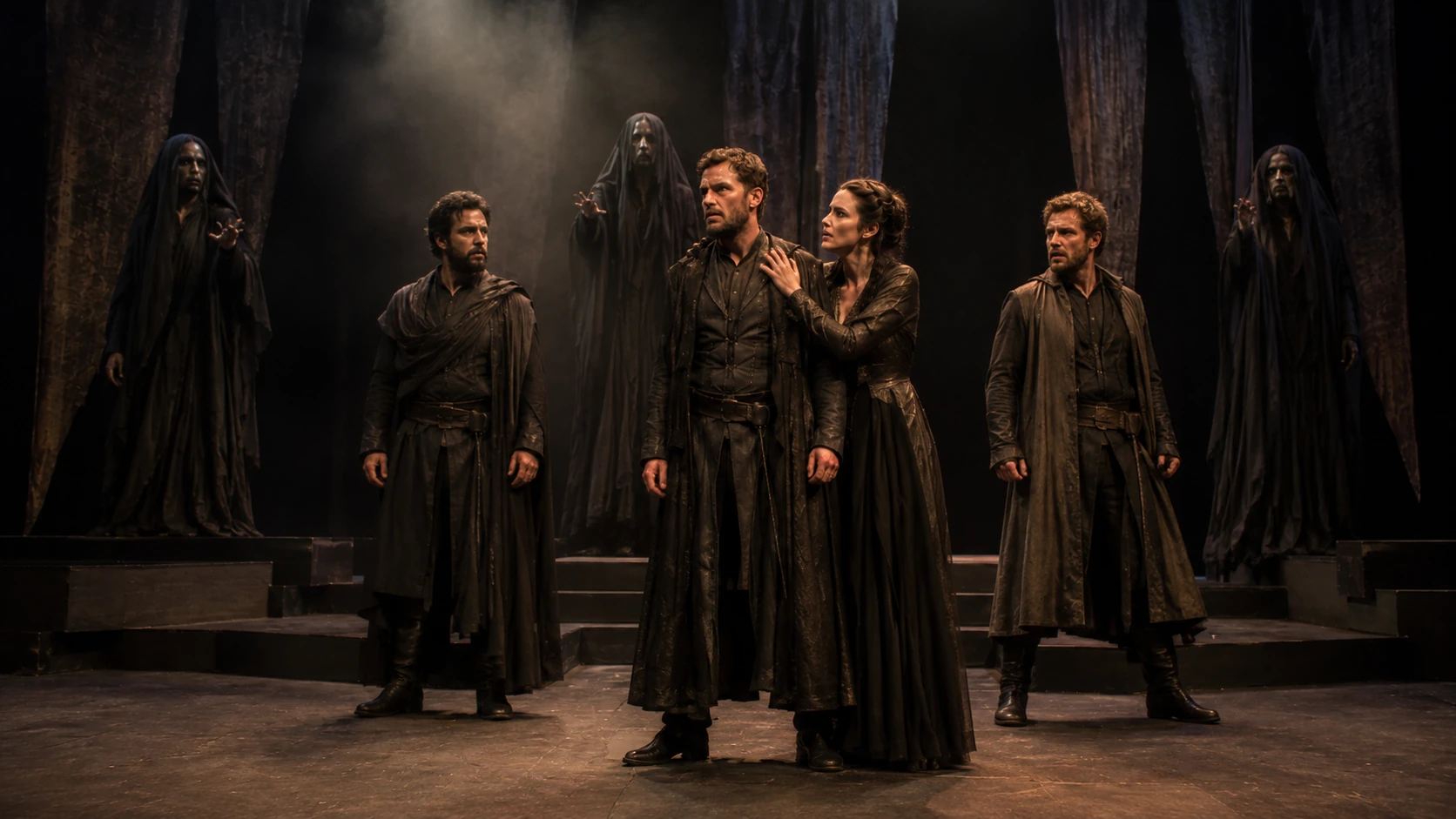
What this task rewards: The Character Arc
You lose marks if you describe a character the same way in Act 1 as Act 5. Macbeth is a tragedy about psychological decay. Strong responses contrast vocal and physical skills across the journey.
Character Arc Profiles
Choose a character to see how an actor could communicate their journey physically and vocally.
Macbeth
The Tragic Hero's Decay
Act 1: The Noble Warrior
Before the murder, Macbeth is celebrated as a brave soldier. A performance can establish confidence and status clearly enough that later changes in behaviour register with the audience.
- Voice: A measured pace or secure projection could suggest confidence; choose the vocal quality that fits the line and relationship.
- Posture: An open, grounded stance is one option for establishing status before the murder.
- Eye focus: Sustained focus on Duncan or Banquo could suggest ease or confidence, but do not treat eye contact as automatic proof of honesty.
- Proxemics: Comfortable closeness with Lady Macbeth can establish intimacy before that relationship changes.
Act 3–5: The Paranoid Tyrant
After the regicide, Macbeth becomes increasingly fearful, violent and isolated. Build a clear progression rather than playing every later scene at the same level of agitation.
- Voice: Changes in pace, pause, volume or vocal control can distinguish command, fear and private thought.
- Posture: Increased muscular tension or guardedness could contrast his earlier confidence.
- Movement: Restlessness is one option; controlled stillness can be just as unsettling in moments where Macbeth is trying to hold power.
- Proxemics: Track who Macbeth approaches, excludes or avoids as his relationships deteriorate.
Lady Macbeth
From Dominance to Madness
Act 1–2: The Manipulator
Lady Macbeth initially takes a forceful role in planning and persuading Macbeth. Performance choices should track when she leads, pressures, reassures or loses control rather than giving her one fixed “cold” quality.
- Voice: Contrast persuasion with challenge through pace, pitch, pause or articulation at specific lines.
- Proxemics: Closing distance can apply pressure, while deliberately withholding contact can create a different kind of control.
- Levels: A raised level can support status if the staging makes the relationship visible and sightlines remain clear.
- Gestures: Choose contact carefully and safely; a small controlled gesture may carry more authority than constant grabbing or pointing.
Act 5: Sleepwalking & Loss of Control
The sleepwalking scene shows a profound loss of the control Lady Macbeth displayed earlier. Build the contrast from the text rather than trying to diagnose the character.
- Voice: Fragmented rhythm, changes in volume or uneven breath are possibilities; tie them to the exact lines and pauses.
- Gestures: The text supports repeated hand-washing action; decide its size, rhythm and precision.
- Eye focus: Limited awareness of the Doctor and Gentlewoman can help separate the private action from the observers.
- Posture: Tension, fatigue or reduced spatial confidence can contrast earlier scenes without requiring a permanently slumped body.
The Witches
The Unnatural Prophecy
The text makes the Witches uncanny and difficult to categorise. A production can treat them as overtly supernatural, recognisably human, or somewhere between; the acting style should support that concept consistently.
Non-Naturalistic Ensemble Skills
- Choral speaking: Brief unison or shared rhythm can connect the Witches, but individual voices can be equally effective.
- Physical vocabulary: Repetition, stillness, mirroring or contrasting movement can establish how closely the three figures are linked.
- Levels & proxemics: Decide whether they cluster, surround Macbeth or occupy separate points in the space, then link the pattern to your concept.
- Vocal quality: Experiment with pitch, resonance, pace and overlap rather than defaulting to stock screeches or growls.
Banquo & Macduff
The Honourable Foils
A foil is a character whose traits highlight the protagonist’s flaws. Banquo and Macduff represent honour Macbeth abandons.
Banquo (The Resistor)
Banquo hears the same prophecies as Macbeth but refuses to act on them. He represents loyalty and reason.
- Voice: A steadier rhythm can contrast Macbeth at selected moments, but let Banquo’s suspicion and uncertainty change the delivery where appropriate.
- Posture: Use posture and eye focus to show his changing response to Macbeth rather than treating openness as proof of virtue.
- As a Ghost: Stillness, slow movement, direct focus or complete disregard of Macbeth are alternative production choices; decide whether the audience should read the figure as supernatural, psychological or theatrically ambiguous.
Macduff (The Avenger)
Macduff is driven by grief and restoring order, not ambition.
- Act 4 (Grief): Explore pause, disrupted breath, stillness, movement or changes in vocal control. Avoid assuming grief has one physical shape.
- Act 5 (Confrontation): Build purpose through focus, pace and spatial commitment; contrast Macbeth only where the scene and your interpretation justify it.
📝 Eduqas: The Exam Builder
Generate a model paragraph linking character arc to acting/directing/design choices.
Click “Draw New Concept” to generate an integrated exam paragraph...
Synopsis & Journeys
Track the tragic descent from war hero to tyrant king.
Context & History
King James I, witchcraft, and the Divine Right of Kings.
Characters & Acting
Playing guilt, supernatural possession, and shifting status.
Scenes & Proxemics
Interactive staging for the Witches, Banquets, and Battles.
Themes & Quotes
Ambition, the supernatural, and corrupted masculinity.
Design Elements
Castles, heaths, bloody costumes, and supernatural lighting.