Costume Design
Edwardian Restriction vs. Working-Class Pragmatism
Turn the interpretation into your own design
Open the standalone Costume Lab and choose An Inspector Calls to compare period costume interpretations, inspect detail, test readability and build an explanation.
Open Costume Lab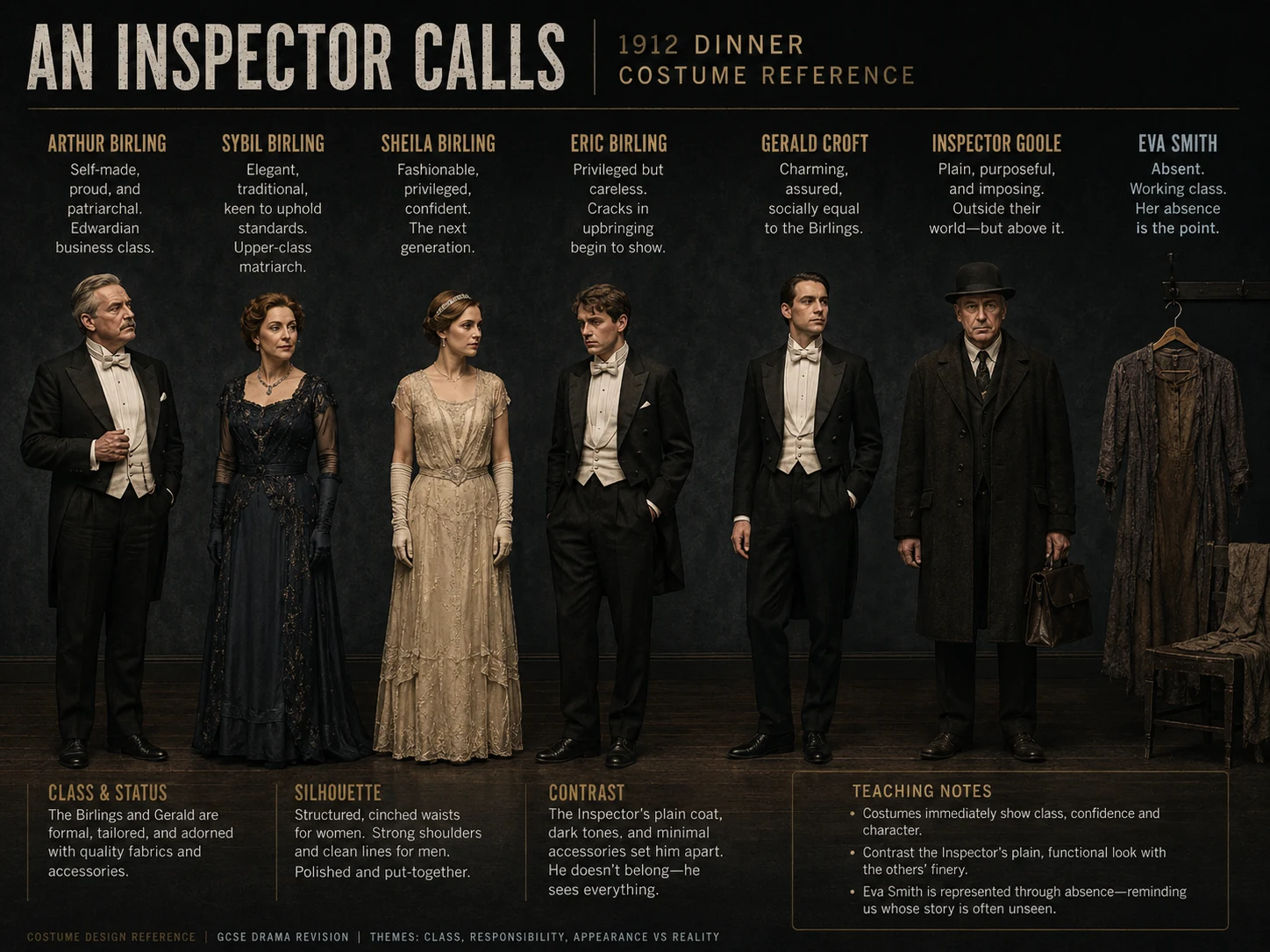
Costume prompt: which changes in fabric, silhouette and finish could separate the Inspector from the polished Birling household?
What this task rewards: Visualizing Class & Status
Do not simply describe what the characters are wearing. A strong response should show how you use fabric, silhouette, and fit to communicate Priestley's themes. The Birlings' clothing must visually represent their suffocating capitalist wealth, while the Inspector's attire must contrast this entirely, representing the harsh, classless reality of the outside world.
The Birlings (Edwardian Extravagance)
Priestley explicitly states they are in "evening dress of the period." This is highly formal 1912 White Tie. It is expensive, impractical, and highly restrictive, physically forcing the actors to adopt rigid, haughty postures.
👔 The Men (White Tie)
Arthur, Gerald, and Eric wear black tailcoats, heavily starched white shirts, and stiff wing collars. The collar is crucial: it physically restricts their neck movement, visualizing their rigid, inflexible capitalist views and their inability to 'look around' at the suffering of the working class.
👗 The Women (Corsets & Silk)
Sybil and Sheila wear heavy silk or velvet evening gowns built over tight corsets. The expensive fabrics display their immense wealth, but the corset physically binds their breathing. This mirrors how Edwardian society emotionally suffocated women, keeping them entirely dependent on the patriarchal system.
The Inspector (Classless & Timeless)
The Inspector is an anomaly. Priestley describes him in a "plain darkish suit." However, strong answers frequently reference his iconic outer garment, popularised by Stephen Daldry's 1992 production.
🧥 The Mackintosh Raincoat
Instead of a formal overcoat, he wears a heavy, belted, working-class Mackintosh raincoat. This gives him a broad, imposing silhouette that instantly clashes with the Birlings' delicate silks. It suggests he has brought the harsh, stormy reality of the real world straight into their comfortable dining room.
🎩 The Slouch Hat / Fedora
Wearing a hat indoors was a major breach of Edwardian etiquette. By keeping it on, the Inspector immediately shows his disregard for their class rules. Furthermore, pulling the brim down casts a harsh shadow over his eyes, emphasizing his omniscient, "Goole" (ghoul-like) and mysterious nature.
Eva Smith (The Absent Working Class)
Eva never appears on stage. However, as a designer, you can still use costume symbolically to bring her physical presence and Priestley's socialist critique into the room.
🧵 Symbolic Props (The Factory Apron)
The Inspector could carry a distressed, grease-stained rough cotton apron belonging to Eva, placing it directly onto the pristine mahogany dining table. The stark contrast between her cheap, dirty workwear and their spotless crystal glasses creates a powerful visual metaphor for capitalist exploitation.
💍 The Engagement Ring
While a prop, Sheila's ring acts as a costume signifier. It is a symbol of patriarchal ownership and capitalist materialism. When she physically removes the ring and returns it to Gerald in Act 2, she strips away her Edwardian status, visually confirming her moral awakening.
📝 AO3/AO4 Response Builder
Use these pre-structured sentences in your Component 3 exam to instantly hit the higher levels of response for justifying your costume design.
| Design Element (What) | Impact Justification (Why) | Key Terminology |
|---|---|---|
| I would dress Arthur Birling in a heavy woollen tailcoat with a highly starched, stiff wing collar. | This deeply uncomfortable Edwardian garment physically restricts his movement on stage, visually communicating to the audience his rigid, inflexible capitalist mindset and his inability to look beyond his own social class. | Silhouette Fit (Restrictive) Capitalist Status Physical Tension |