Characters & Acting
Use the staging image and character buttons to turn visual ideas into precise acting choices.
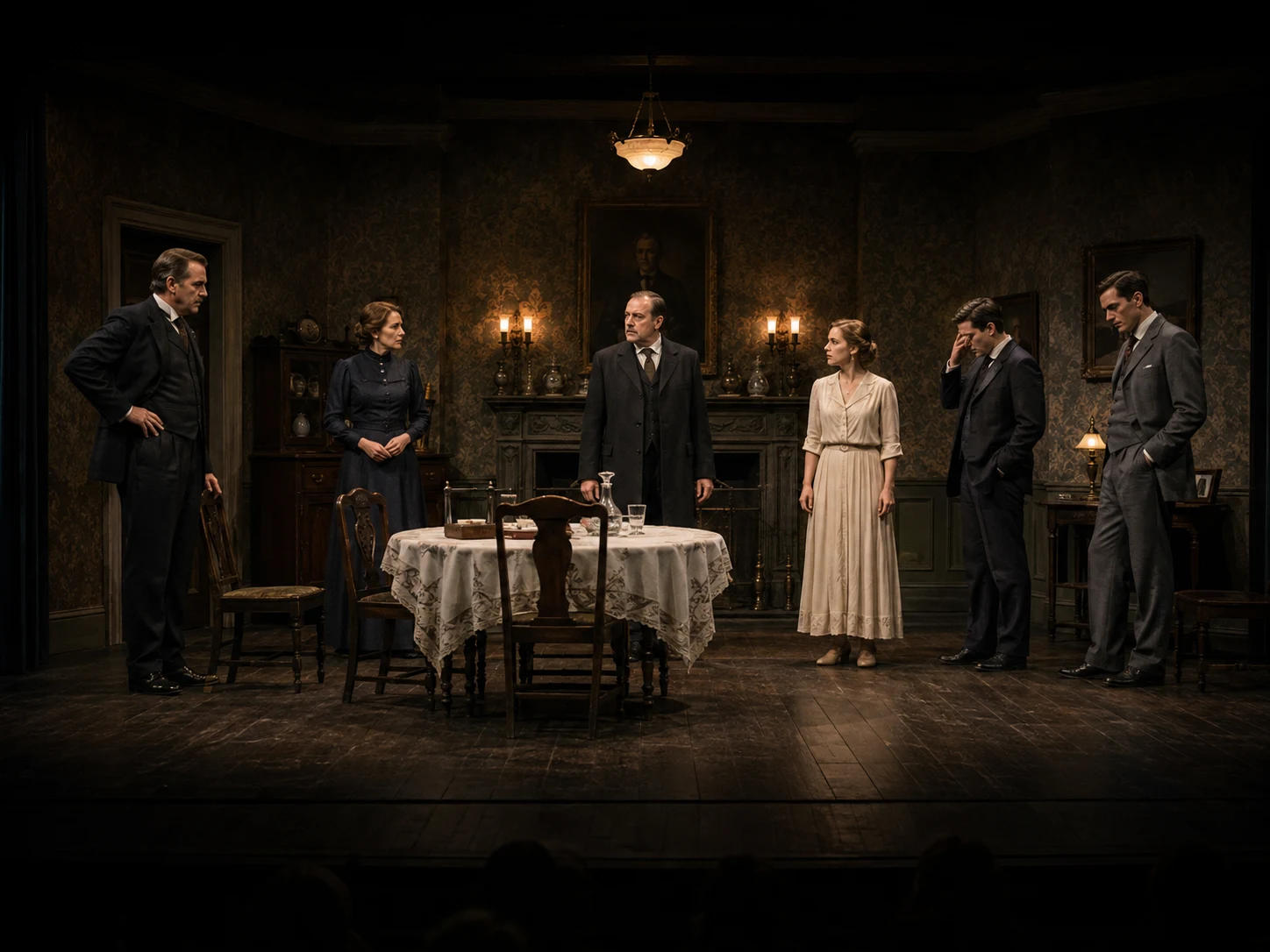
Choose a character profile to explore acting choices, status and audience effect.
Inspector Goole
The Catalyst | Omniscient | Priestley's Proxy
The Inspector is not a traditional police officer; he is a dramatic device used to shatter the Birlings' capitalist microcosm. An actor must play him with unwavering authority, focusing heavily on timing and spatial dominance to physically corner the family.
🗣️ Vocal Authority
Speaks "carefully, weightily." Use a measured, resonant pitch and deliberate pauses before answering. This creates an uncomfortable silence that forces the Birlings to fill the void, often incriminating themselves.
🚶 Proxemic Dominance
He does not skirt around the edges. He should walk directly and linearly through the space, physically breaking the Birlings' conversational circles. He controls the photograph, dictating exactly where the other actors must move.
Arthur Birling
Capitalist Patriarch | Arrogant | Socially Insecure
Arthur represents the greed of Edwardian capitalism. Despite his wealth, he is deeply insecure about his social status compared to the Crofts, overcompensating with bluster, long-winded speeches, and aggressive physical posturing.
🗣️ Vocal Skills
One approach is a broad, confident projection with an expansive pace when Birling lectures the room, then a quicker or sharper delivery when challenged. If you choose a regional accent, make it consistent with your production setting; do not use accent as automatic shorthand for class or intelligence.
🚶 Physical Skills
Expansive gestures to physically claim the space, reflecting his capitalist greed. A chest-out, puffed-up posture. When challenged by the Inspector, his gestures become sharp, pointed, and erratic.
Sybil Birling
Class-Prejudiced Matriarch | Cold | Unyielding
Sybil is Arthur's "social superior." She is an embodiment of upper-class hypocrisy and wilful blindness, refusing to take any responsibility for Eva's death until she realizes she has inadvertently condemned her own son.
🗣️ Vocal Skills
Controlled diction, deliberate pace and economical emphasis can communicate Sybil’s social confidence and judgement of others. RP is one possible production accent, not a requirement; status can be made clear through vocal control, interruption and who she expects to listen.
🚶 Physical Skills
A rigid, upright posture, completely lacking in maternal warmth. She maintains maximum proxemic distance from the Inspector, using the furniture (like her armchair) as a defensive fortress against his questioning.
Sheila Birling
The Awakened Conscience | Empathetic | Dynamic Arc
Sheila offers the most dynamic acting challenge, transforming from a naive, materialistic girl into a mature, guilt-ridden woman who aligns completely with the Inspector's socialist message.
Acting Her Character Arc
Act 1: The Naive Child
Acting Skills: High-pitched, enthusiastic vocal tone ("Mummy!"). Flitting, light movement around the stage. Fawning physically over the engagement ring, demonstrating her initial materialism.
Act 2 & 3: The Inspector's Proxy
Acting Skills: Posture drops, grounded and still. Vocal tone becomes lower, steady, and urgent. By Act 3, she adopts the Inspector's direct eye contact and cutting proxemics to interrogate her own parents.
Eric Birling
The Fractured Youth | Guilty | Isolated
Described as "half shy, half assertive," Eric is clearly uncomfortable in his own home. His secret drinking problem and heavy guilt over his treatment of Eva Smith cause him to visibly unravel on stage.
🗣️ Vocal Skills
Stuttering, disjointed pacing. Sudden, uncontrolled outbursts of volume when his father triggers him. A slurred articulation to visually and audibly communicate his drunkenness to the audience.
🚶 Physical Skills
A slouched, defeated posture. He is constantly moving towards the decanter (a key prop and proxemic anchor). Hands thrust deep into his pockets, avoiding eye contact with his family.
Gerald Croft
The Aristocratic Ally | Deceptive | Unchanged
Gerald is the aristocratic ideal Arthur aspires to. While he shows temporary, genuine grief over Daisy Renton, he quickly reverts to his capitalist mindset in Act 3, leading the charge to prove the Inspector was a fake.
🗣️ Vocal Skills
A smooth, confident, and persuasive tone. He uses a patronizing, gentle pitch when trying to control Sheila. In Act 3, his pace quickens excitedly as he uncovers the "hoax."
🚶 Physical Skills
A relaxed, suave posture. He easily claims the physical space, standing shoulder-to-shoulder with Arthur. When his affair is revealed, his posture stiffens, and he turns his back to the audience to hide his distress.